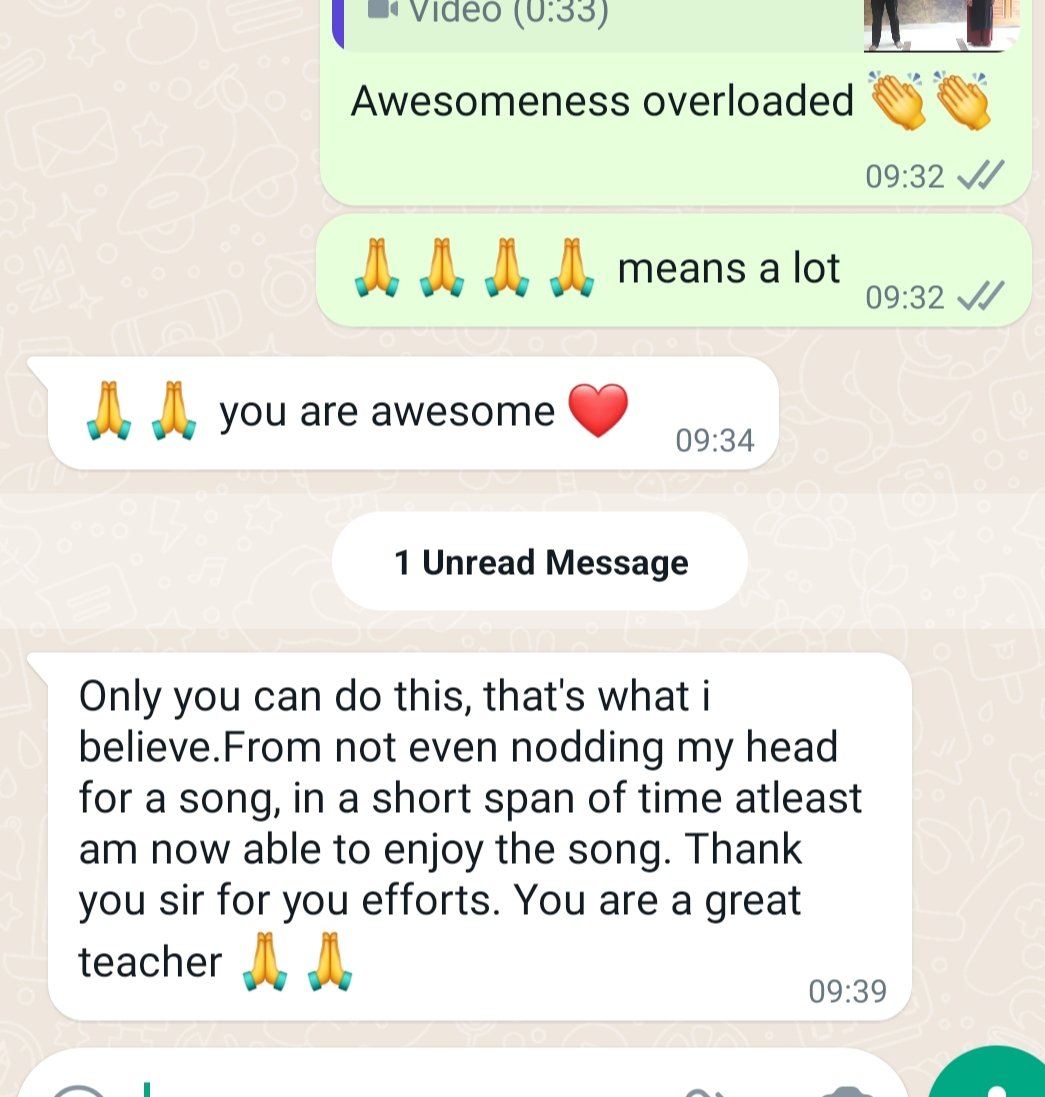
“From not even nodding my head for a song, in a short span of time I am now able to enjoy the music.
Thank you, sir. You are a great teacher.”
One short WhatsApp message … yet inside it lives an entire journey of body confidence, brain chemistry, and emotional freedom.
Let’s unpack it in simple English, line-by-line, with clear Science behind every shift.
1. “Not even nodding my head…” — The Paralyzing Power of Social Fear
Many adults freeze when asked to move in front of others.
Neuroscientists call this action inhibition: the brain’s motor cortex stays “on hold” because the amygdala (our fear center) predicts embarrassment. ¹
That’s why the very first victory is often the smallest motion: a head-nod.
2. Why One Safe Space Can Melt That Fear
Our classes use mirroring, laughter, and zero-judgement rules.
Psychology labels this a low-threat learning environment; it lowers cortisol and unlocks the mirror-neuron network, which fires both when you watch and when you try a move. ²
Result: the body feels safe enough to experiment.
3. “Able to enjoy the song…” — How Movement Changes Music
As soon as you move to rhythm, the brain’s auditory areas couple with the premotor cortex in a process called sensorimotor entrainment. ³
This coupling boosts dopamine by up to 9 % ⁴, turning listening into joyful feeling.
No wonder the student now “enjoys” the song instead of merely hearing it.
4. Momentum in Minutes: The Snowball Effect of Micro-Wins
A study on absolute beginners showed that one successful 30-minute dance session raised self-efficacy scores by 22 % within a week. ⁵
That fresh confidence makes people try bigger moves, leading to faster progress—exactly what happened here.
5. The Teacher Effect — Why Guidance Matters
The student writes, “Only you can do this.”
Good coaching provides:
| Teaching Element | Brain/Body Benefit | Evidence |
| Step-by-step scaffolding | Prevents cognitive overload | Sweller 2011 ⁶ |
| Immediate positive feedback | Releases oxytocin → trust & motivation | Zak 2013 ⁷ |
| Social bonding rituals (claps, emojis) | Elevates endorphins & group cohesion | Dunbar 2012 ⁸ |
When these align, learners attribute success to the teacher and themselves—creating lasting loyalty.
🌱 Your Take-Away
If you can tap your foot while reading this, you already have rhythm.
All you need is a safe space to let it grow.
For ₹200 you can test it yourself in our 5-day online workshop.
Zero judgement. Daily micro-wins. Dopamine included.
👉 https://learn.anyonecandance.in/acd
Come nod your head with us—then watch the rest of your body follow.
References
- Dunbar, R. (2012) The social bonding hypothesis for music. Evolutionary Psychology.
- Wulf, G. (2013) Performance & Motor Learning Under Threat.
- Rizzolatti, G. & Sinigaglia, C. (2016) The Mirror Mechanism.
- Repp, B. & Su, Y. (2013) Sensorimotor synchronization: Human Movement Science.
- Zatorre, R. (2015) Neural reward systems for music. PNAS.
- Kaempfe, T. et al. (2019) Dance intervention & self-efficacy in adults. Arts in Psychotherapy.
- Sweller, J. (2011) Cognitive Load Theory.
- Zak, P. (2013) Oxytocin, trust, and performance. Harvard Business Review.