
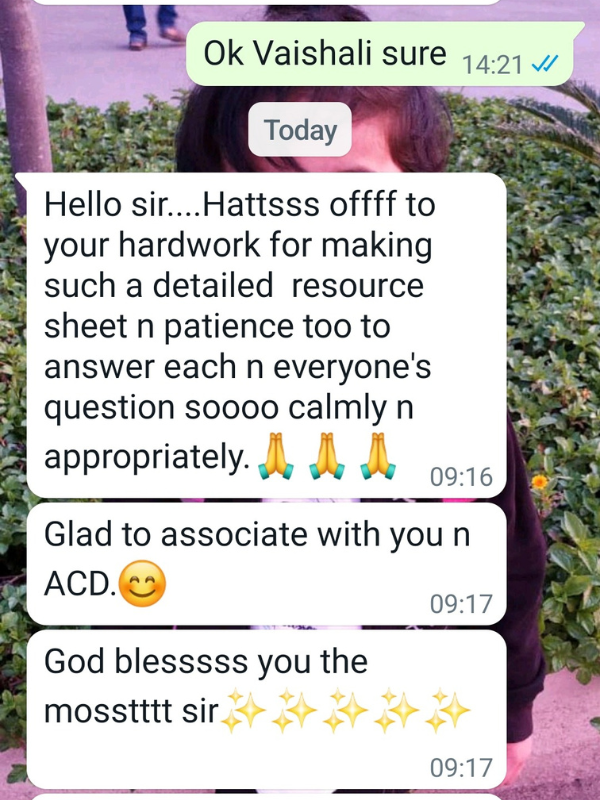
“Hello sir… Hats off to your hard work in making such a detailed resource sheet and showing so much patience in answering each and everyone’s question so calmly and appropriately.
Glad to associate with you and ACD. 😊
God bless you the most, sir! ✨✨✨
I’m going to miss a few classes as I’m traveling from 2nd Nov for my cousin’s marriage—still will try to join.”
On the surface, it’s heartfelt appreciation. But beneath each line lies a powerful lesson in how we learn best, why patience matters, and most of all, why dance is the medium that makes it all possible.
1. Detailed Resources Reduce Overwhelm
When a teacher provides a clear, step-by-step guide, our brains don’t get flooded with too much new information at once. This is called cognitive load reduction—breaking complex tasks into small, manageable chunks so we can learn faster and remember longer (Sweller, 2011)¹.
2. Patience Fuels Persistence
Every question answered calmly builds trust. Psychologists describe this as teacher immediacy—when instructors respond warmly and promptly, students feel seen and supported, boosting motivation and reducing fear of making mistakes (Allen & Seaman, 2007)².
3. Calmness Is Contagious
A softly delivered answer doesn’t just share facts—it soothes anxiety. Research on emotional contagion shows we subconsciously mirror another person’s calm state, which makes us more confident to try, err, and learn (Hatfield et al., 1994)³.
4. Belonging Sparks Joy
Saying “Glad to associate with you and ACD” reveals the power of social identity. When learners feel part of a supportive group, they engage more deeply and stay committed—even when life gets busy (Tajfel & Turner, 1979)⁴.
5. Gratitude Strengthens Bonds
Expressions like “God bless you” aren’t just polite—they release gratitude hormones that reinforce trust and loyalty in a learning relationship (Emmons & McCullough, 2003)⁵. Gratitude makes us more likely to return the favor by showing up again.
6. Resilience Through Self-Efficacy
Despite an upcoming trip, this student plans to “still try” to join. That’s self-efficacy—a belief in one’s ability to overcome obstacles. Positive feedback and a supportive environment raise our self-efficacy, making us stick with our goals even when we travel or face setbacks (Bandura, 1977)⁶.
💃 Conclusion: Dance Is the Real Hero
All of the above—clear resources, patient answers, calm energy, belonging, gratitude, self-belief—find their true power when channeled through dance:
- Dance rewires the brain by linking movement, emotion, and reward centers, releasing dopamine and endorphins that make learning joyful (Kattenstroth et al., 2013)⁷.
- Dance builds a resilient body-mind, improving posture, balance, and stress resilience—even after one class (Quiroga Murcia et al., 2010)⁸.
- Dance creates community, a shared rhythm that dissolves isolation and forges lasting bonds (Quiroga Murcia et al., 2010)⁸.
In every step, sway, and stretch, you’re not just learning choreography—you’re transforming your brain chemistry, your confidence, and your connections.
If you’ve ever hesitated, missed a class, or doubted your rhythm—this is your invitation to experience dance’s life-changing magic firsthand.
Join our next 5-day online dance workshop for just ₹200
No matter where you are, dance will carry you through.
👉 Sign up now: https://learn.anyonecandance.in/acd
Because at ACD, dance isn’t just the lesson—it’s the transformation itself.
References
- Sweller, J. (2011). Cognitive Load Theory. Psychology of Learning and Motivation.
- Allen, I. E., & Seaman, J. (2007). Teacher Immediacy and Student Satisfaction in Online Education. Journal of Online Learning.
- Hatfield, E., Cacioppo, J. T., & Rapson, R. L. (1994). Emotional Contagion. Current Directions in Psychological Science.
- Tajfel, H., & Turner, J. C. (1979). An Integrative Theory of Intergroup Conflict. Social Psychology of Intergroup Relations.
- Emmons, R. A., & McCullough, M. E. (2003). Counting Blessings vs. Burdens: Gratitude & Well-Being. Journal of Personality and Social Psychology.
- Bandura, A. (1977). Self-Efficacy: Toward a Theory of Behavioral Change. Psychological Review.
- Kattenstroth, J.-C., et al. (2013). Dance training and brain plasticity. Frontiers in Aging Neuroscience.